




Two Frontier Open Models in One Day: AI News August 27 2026
If you looked away for 24 hours this week, you missed two frontier open models. On August 26, 2026, Alibaba and Zhipu each shipped a major open-weight release on the very same day, and both are strong enough to change what a team should run. This is the clearest sign yet that the center of gravity in open AI has moved to China, and it is why almost every story in today's roundup is about a model. Below are the 15 biggest AI model stories as of August 27, ranked by how much they change your options right now.
This edition is deliberately model-heavy, because that is where the week's real action was. We cover the two headline drops in depth, then move through the releases, updates, and shifts that matter for anyone choosing a model in 2026. For the bigger picture behind these launches, keep our best AI models of 2026 ranking and our best open source AI models collection open in another tab.
This Month's Notable Model Releases at a Glance
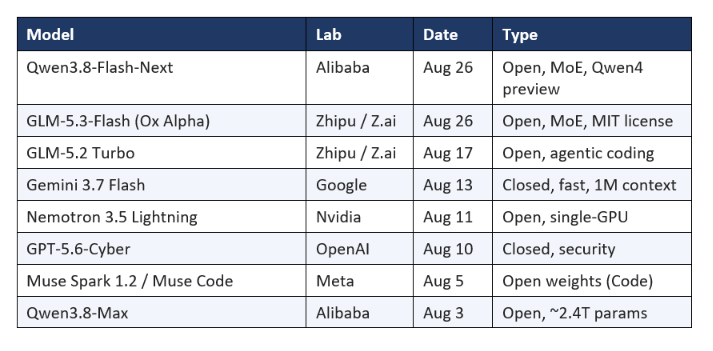
Notice the pattern in that table: open weights dominate, mixture-of-experts is the default design, and Chinese labs set the pace. That is the shape of the AI model race in late 2026, and it frames every story below.
1. Qwen3.8-Flash-Next Drops and Previews the Qwen4 Architecture
Alibaba released Qwen3.8-Flash-Next on August 26, 2026, on ModelScope, and it is the single biggest model story of the week because it is an early look at the Qwen4 architecture. The model is an open-weight, multimodal mixture-of-experts design with roughly 125 billion total parameters and only about 6 billion active per token, shipped in both standard and FP8 versions so people can actually run it. Alibaba is framing it as a technology preview: developers get the new architecture now, and the full Qwen4 family follows later.
The efficiency is the point. Activating only about 6 billion parameters means the model runs far faster and cheaper than its 125 billion total suggests, and the FP8 build brings it within reach of a single strong GPU. Bloomberg reported the release as a smaller, cost-effective Qwen aimed at driving global adoption, with performance Alibaba positions as competitive with Anthropic's Opus 4.6 and DeepSeek's V4-Flash. Hard third-party benchmarks were not published at launch, so treat exact scores as pending.
Why it matters: releasing a new architecture openly and early, before the flagship, lets the whole ecosystem prepare, and it pressures every rival that guards its next design until launch day. We covered the full preview separately, and our Qwen3.8-Max review and Qwen3.8 preview give the family context. If Flash-Next's efficiency holds up in testing, Qwen4 could reset the price-to-performance bar for open models.
2. Zhipu GLM-5.3-Flash Launches, Unmasking the Ox Alpha Stealth Model
Zhipu (Z.ai) launched GLM-5.3-Flash on the evening of August 26, 2026, and revealed it was the stealth model that had been topping usage charts under the codename Ox Alpha. The weights landed on Hugging Face under an MIT license, which is about as permissive as open licensing gets. Reported specs put it at a 320B-A18B mixture-of-experts design with a 1 million token multimodal context, running on Chinese AI chips, with agent benchmarks Zhipu positions as competitive with Opus on GDPVal and DeepSWE, at flash-tier API pricing.
The stealth-launch story is the fun part. Ox Alpha had quietly climbed to the top of online usage charts with high performance at zero cost, and the community spent days guessing who built it. Zhipu confirming it as a GLM model, then releasing the weights the same evening, is a confident move that doubles as a marketing masterstroke. An MIT license on a model this capable means anyone can build on it commercially without friction.
Why it matters: a frontier-adjacent, MIT-licensed, chip-independent model from Zhipu strengthens an already strong open-weight lineup. For where GLM sits, see our GLM-5.3 review and GLM-5.2 review. Landing GLM-5.3-Flash on the same day as Qwen3.8-Flash-Next turned August 26 into one of the biggest open-model days of the year.
3. OpenAI Retires the o3 Model From ChatGPT
OpenAI retired its o3 model from ChatGPT on August 26, 2026, closing a 90-day sunset period. Retirements rarely make headlines, but this one matters because o3 was a workhorse reasoning model for many users and developers, and its removal forces a migration to the newer GPT-5.6 line. Anyone with prompts, workflows, or evals tuned to o3 now needs to re-test against the current models.
This is part of a broader pattern in 2026: labs are pruning older models aggressively to concentrate usage on their newest, most efficient lines. It keeps the fleet lean and steers users toward current pricing, but it also means the ground shifts under teams that built on a specific model. The lesson for builders is to treat any single model version as temporary and to keep an eval suite that makes switching cheap.
Why it matters: model retirements are a hidden cost of building on frontier APIs, and they are becoming routine. If o3 was in your stack, GPT-5.6 Sol, Luna, or Terra are the natural replacements, and you should benchmark them on your own tasks before assuming parity.
4. Two Frontier Open Models in One Day: What It Signals
The fact that Qwen3.8-Flash-Next and GLM-5.3-Flash both shipped on August 26 is itself the story. Two different Chinese labs, two frontier-adjacent open-weight models, one day. This is not a coincidence so much as a signal: the open-weight race has hit a cadence where a single day can bring more capability than an entire quarter used to. For anyone choosing models, the practical effect is that your best open option can change between a Monday and a Wednesday.
It also reframes the competitive map. The most capable open models of 2026 are increasingly coming from Alibaba, Zhipu, DeepSeek, and Moonshot, while much of the closed frontier stays with OpenAI, Anthropic, and Google. That split matters for cost, privacy, and control, because open weights let you run locally, fine-tune, and avoid per-token API bills entirely. A double drop like this accelerates that shift.
Why it matters: if your model strategy assumes a stable leaderboard, this week broke that assumption. The winning approach in 2026 is to stay flexible, keep evals ready, and re-check the open frontier often, because it now moves in days, not months.
5. GLM-5.2 Turbo Cements Zhipu as an Agentic-Coding Leader
Before GLM-5.3-Flash, Zhipu shipped GLM-5.2 Turbo on August 17, 2026, and the community quickly labeled it one of the most reliable open-weight models for agentic coding. It is a large mixture-of-experts model, reported around 753 billion parameters with roughly 40 billion active per token, released under an MIT license. For teams building autonomous coding agents on open weights, it became an immediate default.
Agentic coding is one of the hardest tests for a model, because it demands long-horizon reliability, tool use, and the discipline not to wander off task across many steps. GLM-5.2 Turbo earning that reputation, then GLM-5.3-Flash arriving nine days later, shows how fast Zhipu is iterating. It is a reminder that the open-coding frontier is now a two-horse-plus race between Zhipu, DeepSeek, and a few others.
Why it matters: reliable open agentic coding at MIT-license terms is a big deal for cost-conscious engineering teams. Our comparison of DeepSeek V4 vs Kimi K3 vs GLM is the best place to see how these open coders stack up head to head.
6. Gemini 3.7 Flash Holds Google's Speed-and-Price Lane
Google's Gemini 3.7 Flash, released August 13, 2026, remains one of the most talked-about Western models this week, and for good reason. It scores about 65.3 percent on DeepSWE v1.1 and 43.6 percent on FrontierCode 1.1, keeps the same 1 million token context as 3.6 Flash, and is priced at roughly 0.75 dollars input and 3.75 dollars output per million tokens through 2026. That is a strong speed-to-cost profile for coding and long-context work.
There is a catch worth flagging: the list price is set to double on January 1, 2027, which turns the current rate into a limited-time advantage. For teams that can lock in workflows now, Gemini 3.7 Flash is a compelling value, but the pricing change means you should model your 2027 costs before committing heavily. It is a clever bit of pricing strategy from Google, rewarding early adoption.
Why it matters: Gemini 3.7 Flash is Google's answer to the flood of cheap Chinese models, competing on the same speed-and-price axis. Our Gemini 3.7 Flash review breaks down the benchmarks and the pricing catch in full.
7. GPT-5.6 Luna Becomes the ChatGPT Free-Tier Default
OpenAI made GPT-5.6 Luna the default model for ChatGPT's free tier in August 2026, putting a current-generation model in front of hundreds of millions of casual users at no cost. The GPT-5.6 line spans Sol, Luna, and Terra tracks, and OpenAI also shipped GPT-5.6-Cyber on August 10 for security-focused work. Making Luna the free default is a distribution move as much as a technical one.
The strategic logic is clear. With so many capable free and open models now available, OpenAI cannot let its free tier feel dated, or it risks users drifting to alternatives. Putting a strong GPT-5.6 variant in the free slot keeps ChatGPT sticky at the top of the funnel, where habits form. It is the same competition for default attention that is playing out across every major assistant.
Why it matters: the free tier is the battleground for mainstream mindshare, and OpenAI is defending it with current models rather than last year's. For everyday users, it means the free ChatGPT experience just got meaningfully better.
8. Qwen3.8-Max, the Largest Open-Weight Model Ever, Keeps Spreading
Alibaba's Qwen3.8-Max, released August 3, 2026, remains a landmark of the year as the largest open-weight release ever at about 2.4 trillion parameters. While Flash-Next grabbed this week's headlines for efficiency, Max sits at the other end of the range, offering raw capability for those with the hardware to run it. Together they show Alibaba covering the full spectrum, from tiny efficient models to a trillion-scale flagship.
A 2.4 trillion parameter open-weight model is a statement of intent. It says Alibaba is willing to give away capability that other labs keep locked behind APIs, betting that ecosystem adoption is worth more than short-term API revenue. That bet is reshaping how companies think about building on open versus closed models, especially where data control matters.
Why it matters: the existence of a freely downloadable trillion-scale model changes the ceiling for what open-source teams can build. Our Qwen3.8-Max review covers the specs, the hardware reality, and who it is actually for.
9. Nvidia Nemotron 3.5 Lightning Runs Frontier-ish on One GPU
Nvidia released Nemotron 3.5 Lightning on August 11, 2026, its first open-source model of this wave, and the pitch is that it is lightweight enough to run on a single GPU in a PC. For a company better known for selling the chips everyone else trains on, shipping a capable open model is a notable move, and it lands squarely in the efficiency-first theme of the week.
A strong model that runs on one consumer or workstation GPU matters because it lowers the barrier for local, private AI. Not everyone can or wants to run a trillion-parameter model, and a well-tuned lightweight model often covers real work at a fraction of the hardware cost. Nvidia putting its name on that category signals where a lot of practical deployment is heading.
Why it matters: the most useful model is often the one you can actually run, and Nemotron 3.5 Lightning pushes capable local AI further into reach. It is another data point that 2026 is as much about efficiency as it is about scale.
10. Kimi K3's 2.8T Open Weights Still Reshape the Open Field
Moonshot AI's Kimi K3, whose open weights landed on July 27, 2026, continues to loom over the open-model conversation as one of the largest ever shipped: a roughly 2.8 trillion parameter mixture-of-experts model with 896 experts and about 50 billion active parameters. It was unveiled at the World Artificial Intelligence Conference in Shanghai and briefly triggered a fresh round of market jitters about Chinese open models.
K3's scale and openness set a bar that this week's releases are measured against. When a 2.8 trillion parameter model is freely available, every new open release has to justify itself on efficiency, licensing, or specialization rather than raw size. That pressure is exactly what produced efficient models like Qwen3.8-Flash-Next and GLM-5.3-Flash.
Why it matters: Kimi K3 helped set off the open-weight arms race that August 26 continued. Our Kimi K3 review digs into its benchmarks and how it compares to K2 and the rest of the field.
11. DeepSeek V4-Flash and V4-Pro Round Out the Value Tier
DeepSeek stayed central to the open-model story through August 2026 with its V4 line, including V4-Flash-0731 and the general availability of V4-Pro. DeepSeek remains one of the top-used models on OpenRouter, and its reputation for strong performance at aggressive prices keeps it as a default value pick for many developers, especially for coding and reasoning.
What makes DeepSeek notable in a week of bigger headlines is consistency. It does not always grab the splashiest launch, but it keeps shipping capable, cheap models that hold their place at the top of real usage charts. In a market obsessed with leaderboard peaks, DeepSeek competes on the metric that pays the bills: how many developers actually run it every day.
Why it matters: DeepSeek is a reminder that adoption, not just benchmarks, defines a winning model. Alongside Qwen and GLM, it anchors a Chinese open-model trio that now sets the price-to-performance bar for the whole field.
12. Meta Muse Code Ships With Open Weights
Meta continued its open push in August 2026, with Muse Spark 1.2 and Muse Code arriving on August 5, and Muse Code shipping with open weights. For a Western lab, open-weight coding models are a meaningful counter to the Chinese open-weight surge, and they keep Meta relevant in the part of the market that refuses to depend on closed APIs.
Meta's open strategy has always been about ecosystem gravity: the more developers build on its models, the more the tooling, fine-tunes, and know-how accumulate around them. Muse Code with open weights extends that logic into agentic and coding workflows, exactly where a lot of 2026's practical value is being created.
Why it matters: an open-weight coding model from Meta gives Western teams a home-grown alternative to the Chinese open coders, and it keeps the open field from becoming a one-country story.
13. Claude 5 Family Anchors the Frontier for Quality
At the closed frontier, Anthropic's Claude 5 family, including Opus 5, Fable 5, Mythos 5, and Sonnet 5, remains the quality benchmark many of this week's open models are measured against, with Opus 5 having launched July 24, 2026. When Alibaba positions Qwen3.8-Flash-Next against Opus, it is Anthropic's line it is chasing, which tells you where the bar sits.
Claude's role in 2026 is less about winning every price war and more about defining the top end of reliability, reasoning, and agentic behavior. For teams where quality and safety outweigh cost, the Claude 5 family is still the reference point, and the open models are steadily closing the gap rather than clearly passing it.
Why it matters: the frontier that open models chase is largely Anthropic's, and how close they get to Claude is the real measure of progress. Our Claude Opus 5 review covers where the current top sits.
14. Chinese Models Own the Top of the OpenRouter Usage Chart
As of the latest usage data, the top five most-used models on OpenRouter are all from Chinese companies, spanning Tencent, Xiaomi, DeepSeek, MiniMax, and Zhipu. That is a striking shift from a year ago, and it is the through-line connecting almost every story in today's roundup: the models developers actually reach for are increasingly open and increasingly Chinese.
Usage charts cut through marketing in a way benchmarks cannot. A model tops real usage when it is good enough, cheap enough, and available enough that developers keep choosing it. Five Chinese models holding the top of that chart means the open-weight, low-cost strategy is not just winning headlines, it is winning production traffic.
Why it matters: where developers spend their tokens is the truest leaderboard, and right now it points east. For the full ranked picture, our best AI models of 2026 tracks who leads on quality, price, and use case.
15. The Real 2026 Story: Pick the Right Model Per Task
Step back from the individual launches and the meta-story of the week is simple: models now ship so fast that competitive advantage comes from picking the right model for each task, at the right price, with the right privacy rules, rather than betting on one model to rule them all. August 26 alone gave developers two new frontier open options, and that pace is the new normal.
The practical takeaway for teams is to stop chasing a single best model and build a lightweight process instead: keep an eval suite, know which model wins each of your real tasks, and re-check monthly because the answer keeps changing. The mixture-of-experts efficiency behind models like Qwen3.8-Flash-Next and GLM-5.3-Flash is exactly what makes this abundance possible. If the architecture is new to you, our mixture of experts explainer is a good primer.
Why it matters: the winners of the AI model era are not the labs alone, but the teams that stay flexible enough to use the best model for each job. On August 27, 2026, that flexibility is worth more than loyalty to any single name.
What to Watch Next
Three things are worth watching in the days after August 27. First, independent benchmarks for Qwen3.8-Flash-Next and GLM-5.3-Flash, since both launched with vendor framing but limited third-party scores, and the real verdict comes from community and independent tests on tasks that matter to you. Second, local-run reports, because the FP8 build of Flash-Next and the MIT-licensed GLM-5.3-Flash both target people who want to run frontier-ish models on their own hardware, and the first wave of setup guides will tell you what is actually feasible.
Third, watch the pricing and the usage charts. Gemini 3.7 Flash's list price is set to double on January 1, 2027, and the OpenRouter top five is almost entirely Chinese open models, so the questions to track are whether Western labs respond on price and whether any single model can hold the top of real usage for more than a few weeks. In a market moving this fast, the safest position is a flexible one: keep your evals current and re-check the frontier often.
FAQ
What AI models were released on August 26, 2026?
On August 26, 2026, Alibaba released Qwen3.8-Flash-Next, an open-weight preview of the Qwen4 architecture with about 125 billion parameters, and Zhipu released GLM-5.3-Flash, the model previously known as the Ox Alpha stealth model, under an MIT license. The same day, OpenAI retired its o3 model from ChatGPT.
What is Qwen3.8-Flash-Next?
Qwen3.8-Flash-Next is an open-weight, multimodal mixture-of-experts model from Alibaba, released August 26, 2026, with roughly 125 billion total parameters and about 6 billion active per token. It previews the next-generation Qwen4 architecture and ships in standard and FP8 versions on ModelScope, with Hugging Face expected to follow.
What is Zhipu GLM-5.3-Flash (Ox Alpha)?
GLM-5.3-Flash is Zhipu's open-weight model launched August 26, 2026, revealed to be the stealth model that had topped usage charts as Ox Alpha. It is reported as a 320B-A18B mixture-of-experts model with a 1 million token multimodal context, MIT-licensed weights on Hugging Face, and agent benchmarks Zhipu positions as competitive with Opus.
Did OpenAI retire the o3 model?
Yes. OpenAI retired the o3 model from ChatGPT on August 26, 2026, at the end of a 90-day sunset period. Users and developers who relied on o3 should migrate to the GPT-5.6 line, testing Sol, Luna, or Terra against their own tasks.
Which AI models are most used right now?
As of the latest OpenRouter usage data around August 2026, the top five most-used models are all from Chinese companies: Tencent, Xiaomi, DeepSeek, MiniMax, and Zhipu. This reflects the strong price-to-performance of recent open-weight Chinese models.
Is Qwen3.8-Flash-Next free to use?
Qwen3.8-Flash-Next is open-weight, so it is effectively free to run if you have the hardware, and it launched on ModelScope in standard and FP8 versions with Hugging Face expected to follow. Open weights mean no per-token license fee for local use, though you still pay for the compute to run it.
What is the biggest AI model news this week?
The biggest AI model news of the week ending August 27, 2026 is that two Chinese labs shipped frontier open-weight models on the same day: Alibaba's Qwen3.8-Flash-Next, previewing the Qwen4 architecture, and Zhipu's MIT-licensed GLM-5.3-Flash, revealed as the Ox Alpha stealth model. Together they made August 26 one of the biggest open-model days of 2026.
Recommended Blogs
- Best AI Models 2026: Full Ranked Analysis and Benchmarks
- Best Open Source AI Models 2026: Full Collection
- GLM-5.3 Review: Is It Really As Good As Fable 5?
- Qwen3.8-Max Review: Specs, Pricing & Honest Take
- Kimi K3 Review: Benchmarks, Pricing, and K2 Comparison

